Why?
Developing software applications and IT systems is a challenging undertaking. Development teams find themselves in a complex environment called a “socio-technical system”, where the quality of interactions among people and between people and technology is crucial for success.
Teams often face difficulties managing their jobs to be done, retaining trust with management or stakeholders, or keeping team morale and psychological safety high (the certainty that you can raise questions, concerns, and ideas without being punished for it). This leads to frustration from management, colleagues and clients, resulting in a waste of money, time, motivation and talent.
On top of that, an estimated one in five people is neurodivergent (including those with ADHD, dyslexia, Tourette’s, or other conditions, and people that are highly sensitive, introverted, autistic, or intellectually gifted). Every development team therefore already thinks, processes, and communicates in very different ways, whether the team realises it or not. Teams perform better when they recognise and integrate those cognitive differences effectively, and that ability is exactly what you build in this game. Recent team research (Van Rijswijk et al., 2025) shows that teams perform better when members recognise each other’s knowledge and thinking differences and put them to use. Research into collective intelligence (Woolley et al., 2010) shows the same pattern: how smart a team is depends little on the individual IQ of its members, and much more on how the team works together, such as equal participation in conversations and social sensitivity (how well members pick up on what the others think and feel). For development teams, this makes it even more important to focus on psychological safety, managing work and cognitive load (the mental effort that work takes), and enabling self-organisation.
What and for whom?
For software developers, engineering managers, product owners/managers, ScrumMasters, and agile coaches. No prior knowledge of neurodiversity is required.
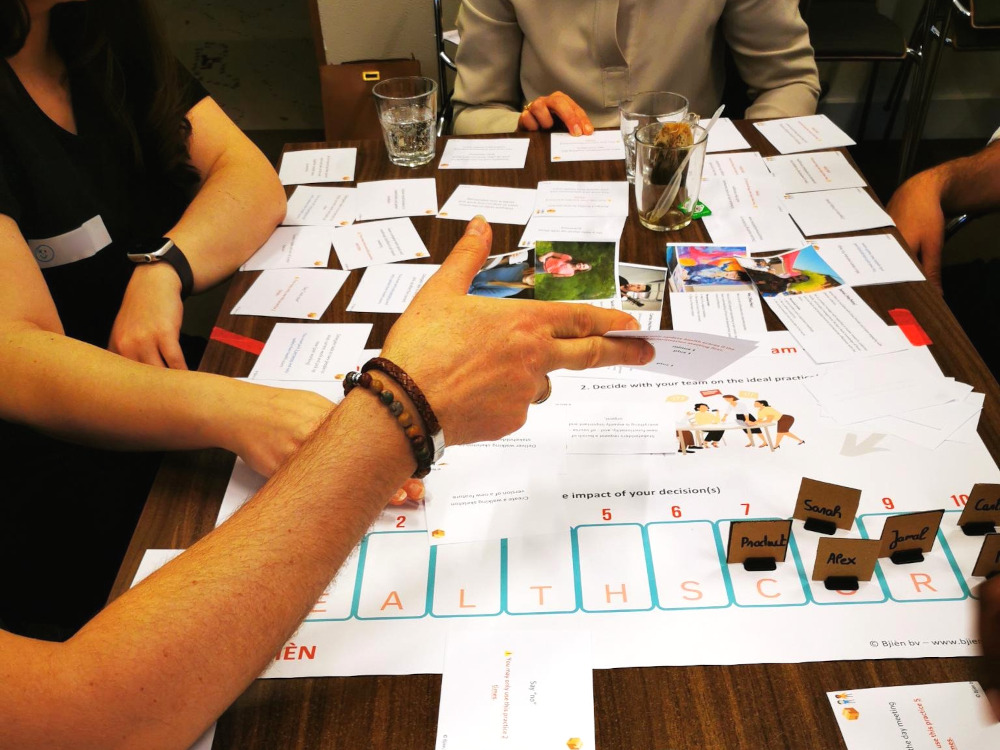
“Becoming a high-performing, neurodiverse software team” is our serious game (a game for learning, not for winning) for software teams. You guide a fictional cloud software development team with fully developed personas through realistic scenarios from the everyday reality of a development team. Each persona thinks, communicates, and works differently, with its own strengths and pitfalls. From a comprehensive set of practices, tools and quick wins based on five simple principles that make the lives of development teams easier, you choose together which approaches to apply. Can you manage the work, build trust, and keep morale high, taking into account the diverse and sometimes opposing personalities, needs and wishes of the personas? There is no ready-made answer; you discover it by playing.
You never play yourself and nobody is measured or assessed: the game is a learning tool, not an assessment. Nor does it simulate limitations: you experience no helplessness, you practise approaches in concrete work situations. You can read why we don’t offer simulation or empathy exercises in our frequently asked questions.
Facilitated during a two-hour session, in English or Dutch. Choose the play format: your team plays the physical board game at the table or the online version of the same game; in both cases one of our facilitators guides the session. The board game itself is in English. Adaptations (i.e. scenarios tailored to your environment) are possible. After the session you will receive a copy of the board game.
By the way, there is also a version for generic teams.
What you’ll learn
Awareness on neurodiversity in the workplace
Learning what neurodiversity means, what stereotypes we unconsciously hold about autism, ADHD, dyslexia, etc., and what the challenges and strengths related to neurodiversity are. Why do neuroinclusion (setting up work so that different thinking, working, and communication styles can thrive) and neurodiversity matter for the whole team and the organisation?
Five principles for development teams
Introducing five core guiding principles that upskill development teams to perform on a higher yet sustainable level, from putting people and well-being first to cognitive ergonomics (designing work and the environment within what people can mentally handle).
How to play the game + debriefing
For ± 45 mins and with assistance from the facilitators, the game is played in smaller groups of about five people. Afterwards, the groups reflect on their learnings and hold a plenary discussion. That is where the payoff of the session lies: not a handout from us, but insights and approaches you tried out yourselves in concrete work situations and that you can immediately link to your own team.
Facilitated by
This workshop is given by an experienced workshop facilitator in the field of neurodiversity at work, who is neurodivergent themselves. Our presentation style allows us to address heavier topics in a fluid and humorous way. We systematically select the speaker who is most aligned with your sector, your company values, and your specific needs. Discover our speakers on our team page.
What others say
Are you interested in a session for your team or organisation?